
The Crowded Dance Floor: Why We Fail to Make Room for Love
“Move! Why aren’t you moving?” the leader asked with visible displeasure. “I gave you such a clear signal. You need to move! Otherwise, how can we dance?!”
The teacher walked over and gently patted the leader’s shoulder. “Your left hand opened up, but your body didn’t make room for her. There is no path for her to get through.”
In that moment, Teacher revealed a universal truth: Leading isn’t just about giving a signal; it’s about creating the space for another person to exist within. This tension isn’t confined to the ballroom; we see it play out in the smallest, most mundane details of our daily lives.
The Psychological “Land Grab”
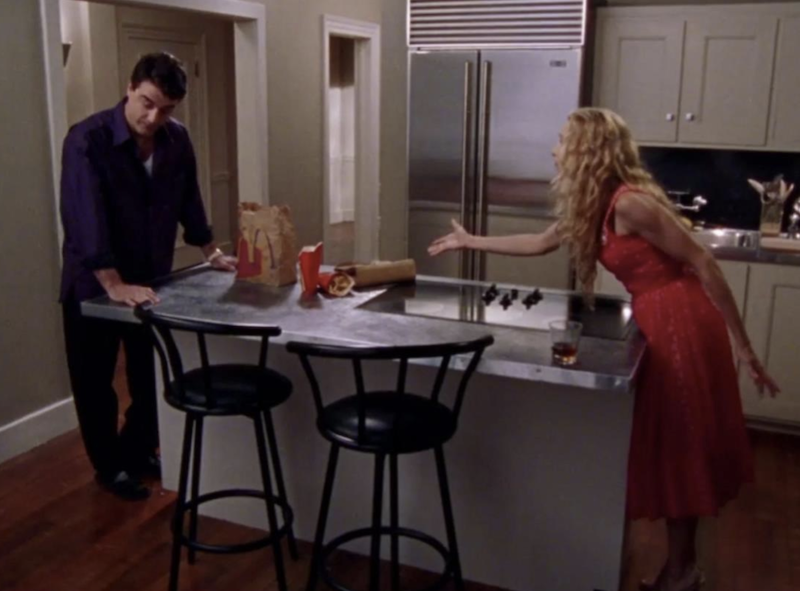
Consider an early episode of Sex and the City, where Carrie complains to her friends that Mr. Big won’t let her keep even the simplest necessities at his place. “I stay over all the time,” Carrie laments, “but I have to carry everything with me because he has this weird thing about stuff”. Samantha’s response is blunt: “Honey, this isn’t a land grab, it’s a relationship! Talk to him!”
When Carrie eventually leaves a trail of belongings — a hairdryer, a toothbrush, a bottle of face wash — Big packs them all into a bag and returns them. This wasn’t just about a cluttered bathroom; it was a clash over the “evolution of the relationship” — a partner’s willingness to provide a stable space for the other to stay, settle, and belong.
But why is that space so hard to provide?
Sometimes, it is because one is not ready to commit (like Big), while at other times, one’s internal “real estate” is already fully booked.
Stolen Space and the Enmeshed Family
According to Murray Bowen’s theory of the Differentiation of Self, a healthy relationship requires a balance between togetherness (our need for attachment) and individuality (our ability to be our own person).
In an “enmeshed” family, the urge for togetherness is a tidal wave. In these systems, children are not encouraged to develop a separate “self.” Instead, they are drafted into emotional roles to soothe their parents’ anxieties. When a person is so tethered to their family of origin, their internal “real estate” is fully booked. There is no psychological room left for their individuality to grow — and consequently, no room for a romantic partner to settle in.
The Consequence: A Relationship Without Room
When a person has not differentiated from their family of origin, they have difficulties in creating a healthy “Us” because there is no developed “Me.” This leads to several painful, crowded dynamics:
- The Emotional Surrogate: The husband who plays the “mama’s boy,” unconsciously compensating for the intimacy his mother lacked with his father. Because he is “tied up” as his mother’s partner even after marriage, he leaves his wife in a “one-person marriage”.
- The Forced Alliance: Because the husband is emotionally absent — anchored to his own parents — the lonely wife feels excluded. She then forms a tight, enmeshed alliance with her children to find the connection her husband cannot provide.
- The Scapegoated Child: The children in these systems often develop depression or anxiety. They are the “identified patients” absorbing the stress of a relationship that has no room to breathe because everyone is too busy being who their family needs them to be.
When these children grow up, history often repeats itself. A son is highly likely to repeat his father’s patterns. A daughter may feel so obligated to soothe her mother’s bitterness or loneliness that she feels “uncomfortable” leaving home to pursue her own self-growth; alternatively, she may try to fight for relational distance by creating extreme physical distance. In these systems, “Individuality” is seen as a threat. If a child chooses their own path over a parent’s whim, the “Togetherness” force reacts with guilt or anger.
Creating the “We-ness”
In any healthy intimacy, there must be three distinct entities: You, Me, and Us. However, if “Me” was never allowed to develop because the family demanded total “Togetherness,” the “Us” will always feel crowded, suffocating, or impossible to maintain.
In Sex and the City, Big saw Carrie’s toothbrush as a ‘land grab’ — an invasion of his physical territory. But for many, the fear is psychological. If you grew up in a family that demanded you always ‘fit in’ rather than ‘stand out,’ your sense of self is likely very fragile. Letting a partner in may feel dangerous; you fear that their presence will be so heavy it will crush the individuality you’ve struggled to build.
It takes two to tango, but those two people must be individuals first. To give your partner space to dance with you, you must first claim the space that belongs to you.
Only then can you stop reacting to the ghosts of your past and start dancing with the person in your arms.
Ch Huang, Counselor